
Endodontic Treatment · Last reviewed May 2026
Root Canal Treatment That Saves
Your Tooth.
Picasso Dental performs root canal treatment in Vietnam across the full range: single-canal incisors and canines, premolars, and complex multi-canal molars, including re-treatment of root canals done elsewhere and endodontic surgery for cases where conventional re-treatment is not possible. Saving your natural tooth is almost always preferable to extraction when the tooth is restorable, and we will tell you honestly when it is not.
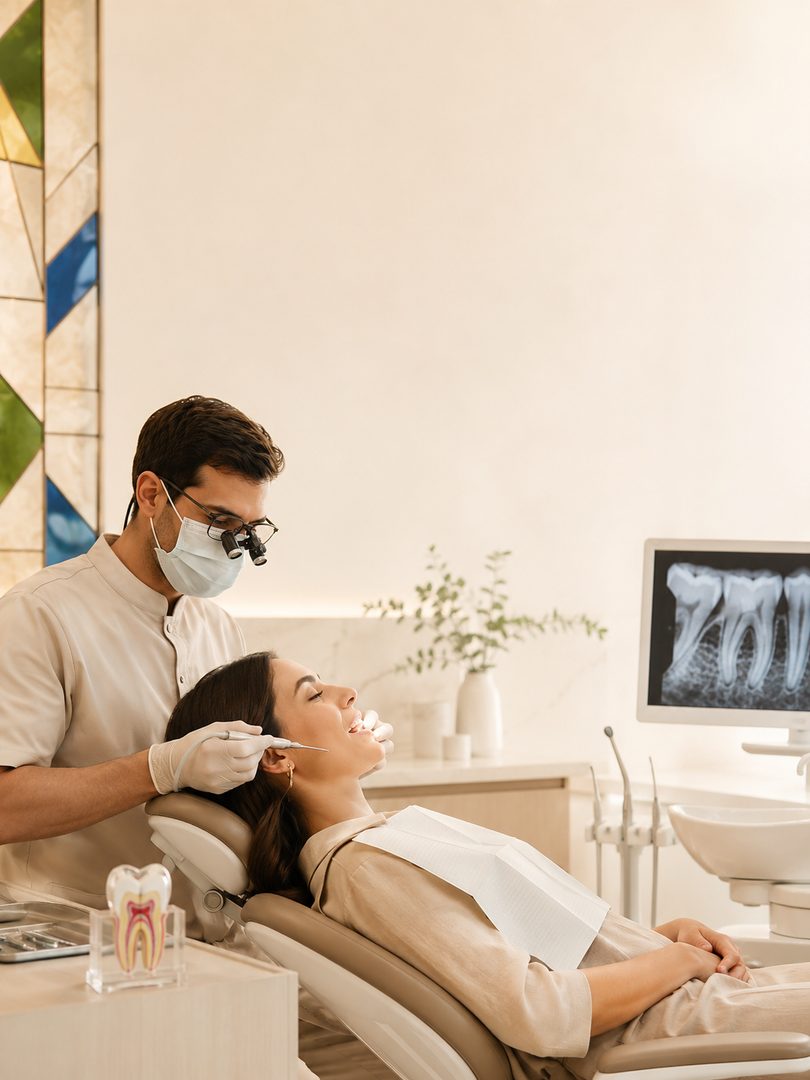
What It Is
What is Root Canal Treatment?
Root canal treatment removes diseased nerve tissue from inside a tooth, cleans and disinfects the root canal system, and seals it with a biocompatible filling material, saving the tooth from extraction. The treated tooth is usually finished with a crown to protect what remains of the natural structure. Modern endodontic treatment is performed under local anaesthetic and is no more uncomfortable than a routine filling.
Single-Canal to Complex Molar Cases
We treat the full range: straightforward single-canal incisors through to multi-canal molars. Re-treatment of root canals previously done elsewhere is also part of our routine work.
Re-treatment Available
If a previous root canal has failed, we offer conventional re-treatment for incisors, premolars and molars, including re-treatment through an existing crown.
Endodontic Surgery
For cases where conventional re-treatment is not possible, endodontic surgery (apicoectomy / root-end resection) is available, surgically treating persistent infection at the tip of the root.
Crown Workflow Integrated
Most root-canal-treated teeth need a crown afterwards. We handle both in the same clinic, using the same digital records. Crown materials in zirconia, Emax, Lava and porcelain-fused-to-titanium.
Six Branches, One Standard
Treatment can be transferred between any of our six clinics in Hanoi, Da Nang, HCMC and Da Lat, useful if a temporary crown debonds while you are travelling, or if you need urgent attention to a treated tooth.
Honest About Saveability
If a tooth is so structurally compromised that a root canal will fail, we will tell you on day one and recommend extraction with an implant or bridge instead. Saving a tooth that cannot be saved wastes your time and money.
Treatment Types
Treatments We Offer
Five distinct endodontic treatments, chosen based on tooth anatomy and whether the tooth has been treated before.
Root Canal: Incisor / Canine
Single-canal anterior teeth, the simplest cases. Often completed in a single visit.
Root Canal: Premolar
Typically 1–2 canals. Slightly more complex than incisors but still routinely completed in one or two visits.
Root Canal: Molar
Typically 3–4 canals, the most complex cases. Usually two visits with intracanal medicament left between for infected teeth.
Root Canal Re-treatment
For teeth where a previous root canal has failed. The previous filling is removed, canals are re-cleaned and re-sealed.
Endodontic Surgery
Apicoectomy / root-end resection, for persistent infection at the root tip when conventional re-treatment is not possible.
MTA & Specialised Materials
MTA (Mineral Trioxide Aggregate) for perforation repair, immature roots and pulp capping. Indirect pulp capping with calcium hydroxide or Biodentine for early-stage pulp protection.
The Procedure
How Root Canal Treatment Works
Five steps over 1–3 visits, depending on case complexity. Most molars need two visits with a 1–2 week gap.
Exam + X-ray
Clinical exam, X-ray and pulp testing to confirm root canal treatment is needed and to map canal anatomy.
Anaesthetic + Access
Local anaesthetic. A small access cavity is opened through the top of the tooth to reach the canals.
Cleaning + Disinfection
Diseased pulp removed, canals shaped with rotary files, disinfected with antimicrobial irrigant. Intracanal medicament for severe infections.
Canal Obturation
The cleaned canals are filled with gutta-percha and sealed against re-infection.
Crown Restoration
Core build-up rebuilds the tooth, then a crown is placed to protect the tooth long-term, particularly important for molars.
Candidates
Who Is, and Isn't, a Good Candidate?
Root canal treatment saves a tooth that would otherwise need extraction. It is the right answer when the tooth is structurally restorable.
You're a Strong Candidate If
Your tooth has irreversible pulpitis, an abscess, or pulp necrosis confirmed clinically or radiographically.
The tooth is structurally restorable: enough natural tooth structure remains for a crown to seat onto.
The surrounding bone is healthy with no extensive periapical destruction beyond what the procedure can address.
You are willing to follow root canal with a crown, particularly for molars.
You can attend 1–3 appointments depending on tooth complexity.
You prefer to keep your natural tooth where this is clinically reasonable.
Root Canal May Not Be Right If
The tooth has a vertical root fracture: extraction is the only option.
The tooth is so heavily broken-down that a crown cannot seat reliably afterwards.
There is severe periodontal disease around the tooth that compromises long-term prognosis.
Non-surgical re-treatment has failed and surgical access is anatomically impossible.
If extraction is the realistic answer, we will say so, and discuss implant or bridge replacement options.
Risks
Risks & Honest Tradeoffs
Root canal treatment is a long-established, predictable procedure, but no dental procedure is risk-free.
What Can Go Wrong
Persistent infection if a canal is missed or bacteria survive disinfection. File separation (rare: a small fragment of file breaks in the canal). Tooth fracture after treatment, particularly without a crown. Re-treatment may be required in some cases.
The Crown Tradeoff
A root-canal-treated tooth without a crown is significantly more prone to fracture, especially molars under chewing load. We strongly recommend a crown after molar root canal. Doing the root canal but skipping the crown to save money often leads to fracture and extraction within a few years.
If the Treatment Fails
Conventional re-treatment is the first option, priced by tooth and access. Where re-treatment is not possible, endodontic surgery (apicoectomy) addresses the root tip directly. Extraction is the last resort.
Post-Treatment Tenderness
Mild tenderness for 2–3 days is normal, managed with over-the-counter pain relief. Severe pain, swelling or fever should be reported immediately. We provide post-treatment contact details and respond to international patients over WhatsApp.
Risk of Doing Nothing
An untreated infected tooth does not heal on its own. It progresses to abscess, can spread to surrounding bone and soft tissue, and may eventually require emergency treatment. Delay rarely improves a root canal candidate.
What We Will Tell You No To
If your tooth is genuinely unsaveable, vertical fracture, severe periodontal compromise, or so broken-down that no crown will hold, we will say so. Doing a root canal on a tooth that cannot be restored afterwards is futile work that we decline.
Pricing
Itemised Root Canal Pricing
Pricing varies by tooth type and complexity. Re-treatment is priced higher than first-time treatment because of the additional work to remove the previous filling and re-clean the canals. For published rate cards across incisor, premolar, molar, treatment-through-crown, re-treatment, endodontic surgery and MTA filling, see the dedicated cost guide.
Need a crown afterwards? See porcelain crowns.
Questions
Frequently Asked Questions
How much does a root canal cost in Vietnam?
The fee depends on the tooth (incisor, canine, premolar or molar), whether it is a first-time treatment or a re-treatment, and whether access is through an existing crown. After your consultation we provide a written, itemised quote. For published rates, see the full pricing index.
Does a root canal hurt?
The procedure is performed under local anaesthetic: you feel pressure, not pain. Most patients describe modern root canal treatment as no more uncomfortable than a routine filling. Mild post-procedure tenderness for 2–3 days is normal and managed with over-the-counter pain relief.
How many visits does a root canal take?
Simple incisor cases can sometimes be completed in a single visit. Most molars need two visits: one to clean and disinfect the canals (with intracanal medicament left in place for 1–2 weeks for infected teeth), and a second to fill and seal. A crown follows at a third visit.
Do I need a crown after a root canal?
Usually yes, especially for back teeth. A root-canal-treated tooth becomes more brittle without its blood supply and is prone to fracture under chewing forces. A crown protects what remains of the natural tooth and significantly extends its lifespan.
Can a root canal fail?
Yes, occasionally. Failure can occur when canals are missed, when bacteria persist, when the seal breaks down, or when the tooth fractures. We offer root canal re-treatment to address most failures, and endodontic surgery for cases where conventional re-treatment is not possible.
What is endodontic surgery?
Endodontic surgery, also called apicoectomy or root-end resection, treats persistent infection at the tip of a root that conventional root canal treatment cannot reach. The infected tissue at the root tip is surgically removed and the end of the root is sealed.
What is MTA filling?
MTA (Mineral Trioxide Aggregate) is a biocompatible material used in specific endodontic situations: sealing perforations, treating immature roots, or as a pulp cap. It is not used in every root canal, only when clinically indicated.
What is the alternative to a root canal?
Extraction is the only alternative, usually followed by a dental implant or bridge to replace the missing tooth. Saving your natural tooth with a root canal is almost always preferable to extraction when the tooth is restorable. We help you weigh the trade-offs honestly.
Start Here
Save Your Tooth. If It's Saveable.
If a tooth is hurting, do not wait. Book a consultation. We will examine the tooth, take an X-ray, confirm whether root canal treatment is the right answer, and quote you in writing before any clinical work begins.