Implant-Supported Dentures · Picasso Dental Implant Team · Last reviewed May 2026
Stop Your Denture Slipping.
For Good.
Picasso Dental places implant-supported overdentures in Vietnam on Osstem, Neodent, Nobel Biocare and Straumann implants, every fixture covered by the manufacturer's original warranty. Snap-on Locator attachments or milled bar retention: your denture clicks firmly into place, removable for cleaning, finally stable when you eat and speak. Implantology at Picasso is led by Dr. Hung Le Ba Gia (Dr. Evans), our Lead Implant Specialist, with 1,000+ implants placed and hundreds of overdenture conversions on record. Two implants in the lower jaw is often enough; four in the upper. Across six branches, two of them inside accredited hospitals.
Savings
Same Implants. Same Attachments. Roughly One Third the Price.
Indicative per-arch overdenture ranges in private practice. Sources: ADA, BDA and AusDent published surveys; Picasso published rate card. Pricing varies by implant brand, number of implants (2 or 4), and attachment type; your written quote follows CBCT review.
| Country | Typical 2-Implant Lower Overdenture | What You'd Save |
|---|---|---|
| United States | $6,000 to $12,000 USD | ~60 to 70% |
| Australia | $8,000 to $14,000 AUD | ~60 to 70% |
| United Kingdom | £4,500 to £8,000 | ~55 to 65% |
| Canada | $6,500 to $11,000 CAD | ~55 to 65% |
| New Zealand | $9,000 to $15,000 NZD | ~60 to 70% |
| Picasso Dental, Vietnam | Osstem to Straumann tiers, see cost guide | — |
Full itemised pricing on the implant cost guide. An overdenture is the most cost-effective full-arch implant option, often less than half the price of fixed All-on-4.
What It Is
What Is an Implant-Supported Overdenture?
An implant-supported overdenture is a removable denture that snaps firmly onto two to four dental implants. Unlike conventional dentures that rest on the gums and slip while eating, overdentures click into place via Locator attachments or a milled bar. You can remove the denture for cleaning, but it does not move while you talk, chew or laugh. It costs less than a fixed All-on-4 bridge, is easier to clean and repair, and dramatically improves quality of life for current denture wearers. The McGill Consensus (2002) named the 2-implant lower overdenture as the minimum standard of care for full lower-arch tooth replacement.
Why Picasso
Why Picasso for Overdentures
Three claims that should be true of any clinic converting a slipping denture into a stable one. Here is exactly how we deliver each one.
Genuine brand implants only, with serial numbers you can verify.
Every overdenture implant at Picasso comes from one of four documented manufacturers, with the original manufacturer warranty and a serial number you can register independently. Attachments are genuine Locator (Zest Dental, USA) or bar systems milled by accredited labs. Spare parts and replacement inserts are available worldwide, so your home dentist can maintain the work after you fly back.
CBCT-planned, conservative surgery, predictable healing.
Every overdenture case begins with a Cone Beam CT scan that maps bone volume in 3D at each planned implant position. Surgery is typically 60 to 90 minutes per arch under local anaesthetic, well tolerated by older patients and those with cardiovascular history. Hospital-based delivery at Vinmec Da Nang is available for patients who prefer the additional safety margin of on-site anaesthesiology.
Existing denture often reused, not always a new one.
Most current denture wearers do not need a brand new denture. If your existing one is in serviceable condition, we cure Locator housings into the underside and convert it on the chair, saving you the cost and the unfamiliar feel of a new prosthesis. If your denture is worn, ill-fitting or aesthetically poor, we make a new one as part of the treatment plan. The decision is yours, after a frank assessment.
CBCT 3D imaging. Every overdenture implant position planned from a bone map before any incision.
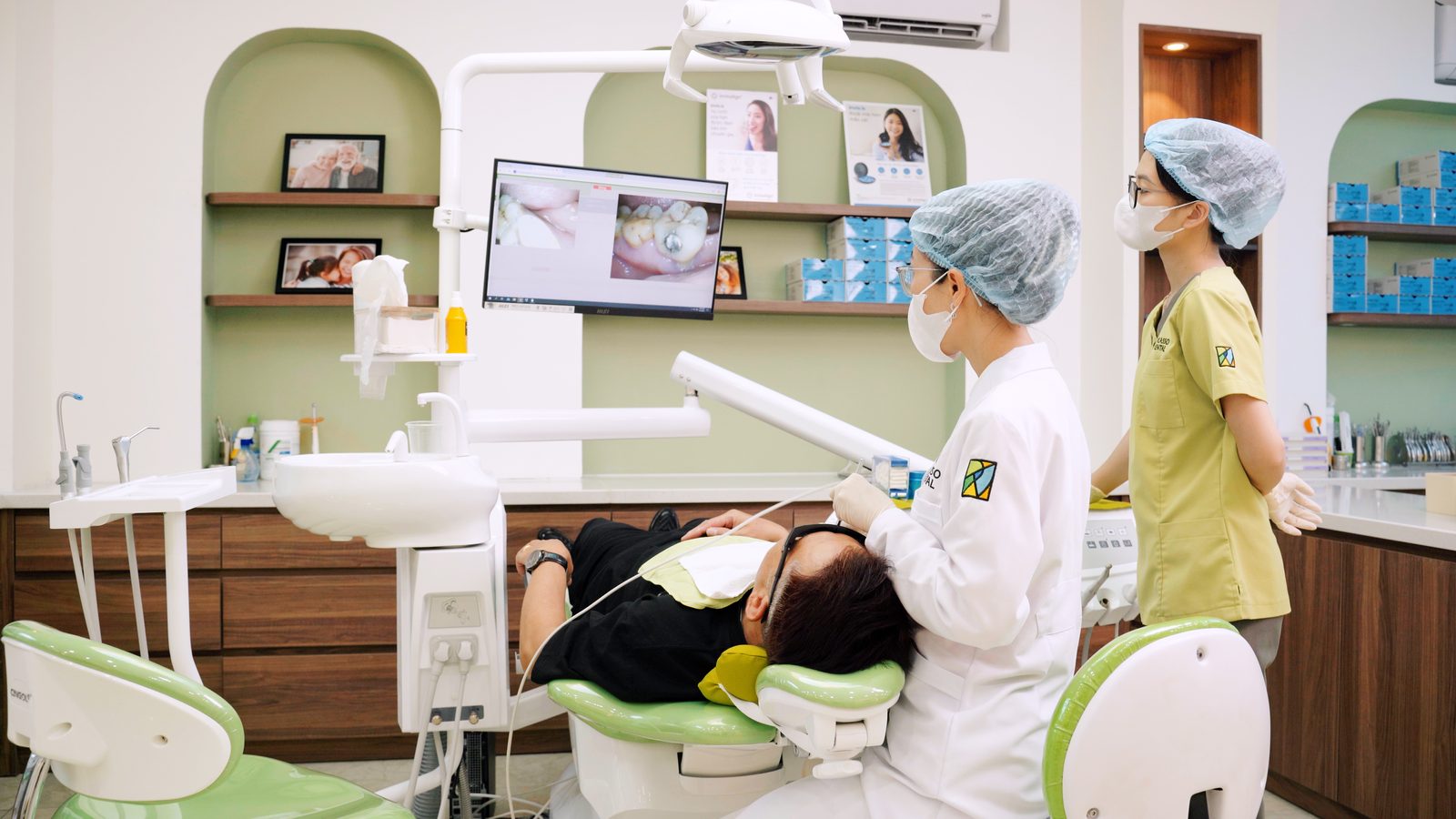
Denture assessment at Picasso Hanoi Old Quarter. Existing denture often reused, not always replaced.
Configurations
Locator vs Bar-Retained Attachments
Two attachment systems hold the denture onto the implants. Locator caps suit most cases; a milled bar is reserved for situations needing maximum stability or splinted load distribution.
| Property | Locator Caps | Bar-Retained |
|---|---|---|
| How it works | Small metal cap on each implant, plastic insert in the denture clicks on | Milled titanium or zirconia bar screwed onto implants, denture clips engage the bar |
| Stability | Very good | Maximum, rigid splinted connection |
| Cost | Standard tier | Higher (custom milled bar) |
| Maintenance | Plastic inserts replaced every 1 to 2 years (5-minute chair-side swap) | Less frequent maintenance, but more complex when needed |
| Bone height needed | Standard | Slightly more vertical bone for the bar profile |
| Cleaning | Easy, brush around each individual cap | Slightly more complex, brush along the bar with floss threader |
| Best for | Most overdenture patients, standard cases | Heavy chewers, severely resorbed ridges, maximum stability |
If you want the absolute stability of a fixed bridge that never moves, see All-on-4. If you want maximum implant count for redundancy, see All-on-6.
Candidacy
Who Is, and Isn't, a Good Candidate?
Implant-supported overdentures suit most adults wearing or about to wear conventional dentures. Decided after your CBCT scan, denture assessment, and a frank conversation about dexterity, smoking and recall commitment.
You're a strong candidate if
- You currently wear a conventional denture and find it slipping, loose or uncomfortable when eating.
- You are about to lose your remaining teeth and want a stable removable solution at lower cost than a fixed bridge.
- You have adequate bone in the front of the jaw for 2 implants (lower) or 4 implants (upper).
- Your gums are healthy, or any active periodontal disease has been treated first.
- If diabetic, your HbA1c is well-controlled (ideally below 7%).
- You have the dexterity to remove and replace the denture daily, and can attend 6-month recall visits for life.
An overdenture may not be right if
- You strongly prefer fixed teeth that you never remove, consider All-on-4 or All-on-6 instead.
- You have limited dexterity that makes daily removal and replacement of the denture challenging.
- You have severely resorbed ridges with insufficient bone for 2 anterior implants; zygomatic implants or staged grafting may be needed.
- You have uncontrolled diabetes or active untreated periodontal disease.
- You are a heavy smoker unwilling to stop at least 2 weeks before surgery and 8 weeks after.
- You expect a denture that never needs maintenance, plastic Locator inserts are replaced every 1 to 2 years.
If any of these apply, we'll tell you, and recommend All-on-4, All-on-6, staged grafting or treatment elsewhere if that's the right answer for your case.
Procedure
The Overdenture Procedure, Step by Step
From your first consultation to a denture that finally stays in place. Total timeline approximately 5 months from surgery to definitive conversion.
Day 1 · 60 min
Consultation & CBCT
Clinical exam, medical history, CBCT 3D scan, denture assessment. Two to four implant positions planned. Brand and attachment system (Locator vs bar) recommended.
Day 2 to 3 · 60 to 90 min
Surgery
Implants placed under local anaesthetic with optional sedation. Existing denture relined to fit immediately, or a new interim denture provided. Same-day discharge.
3 to 4 months
Osseointegration
Implants fuse with the jawbone. Denture worn as a soft-tissue-supported temporary during this period. WhatsApp check-ins if you have travelled home.
2 visits · 1 week
Denture Conversion
Locator caps or bar fitted onto the implants. Matching attachment housings cured into the underside of the denture. Denture now clicks firmly into place. Implant passport and warranty documentation handed over.
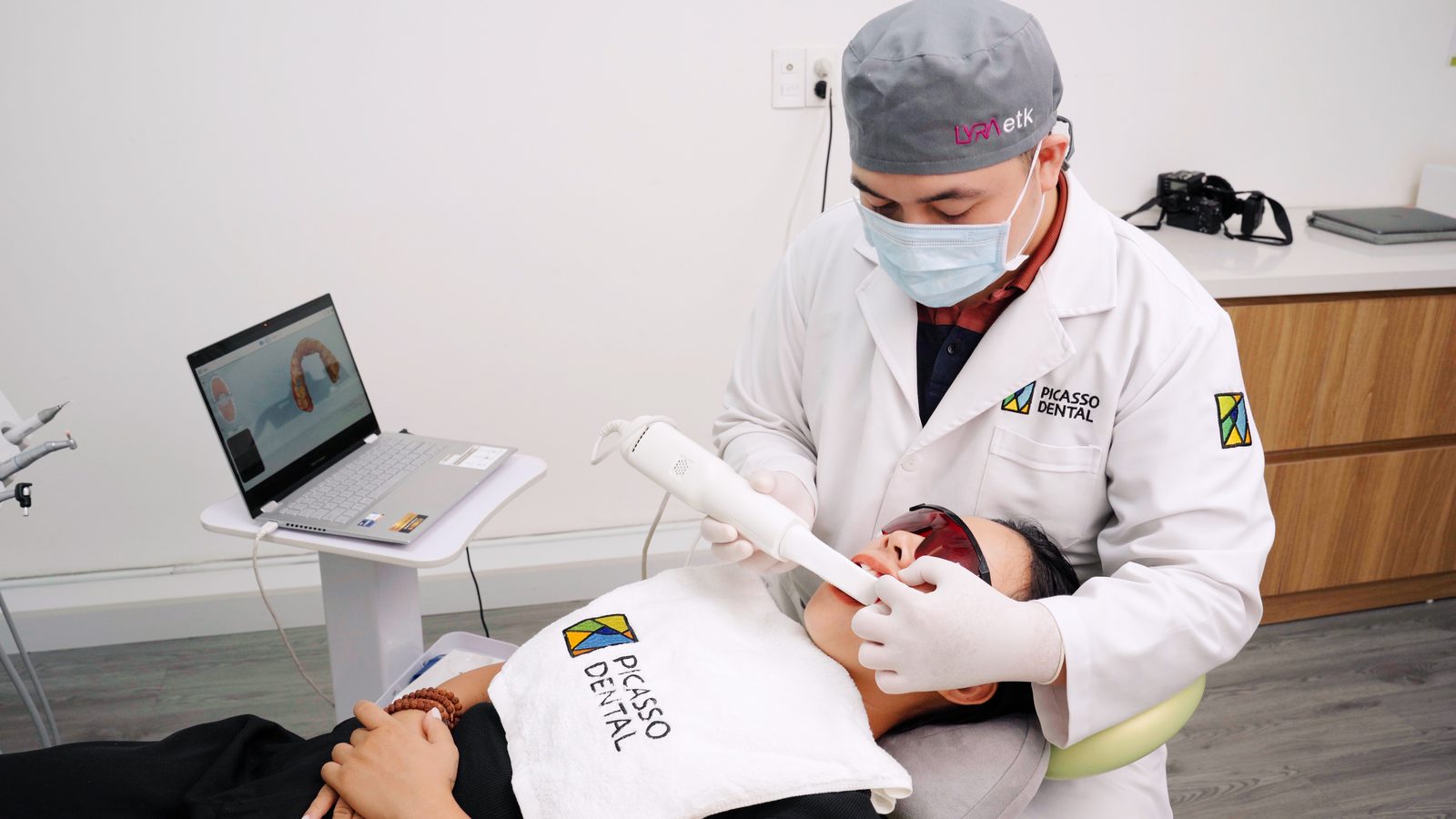
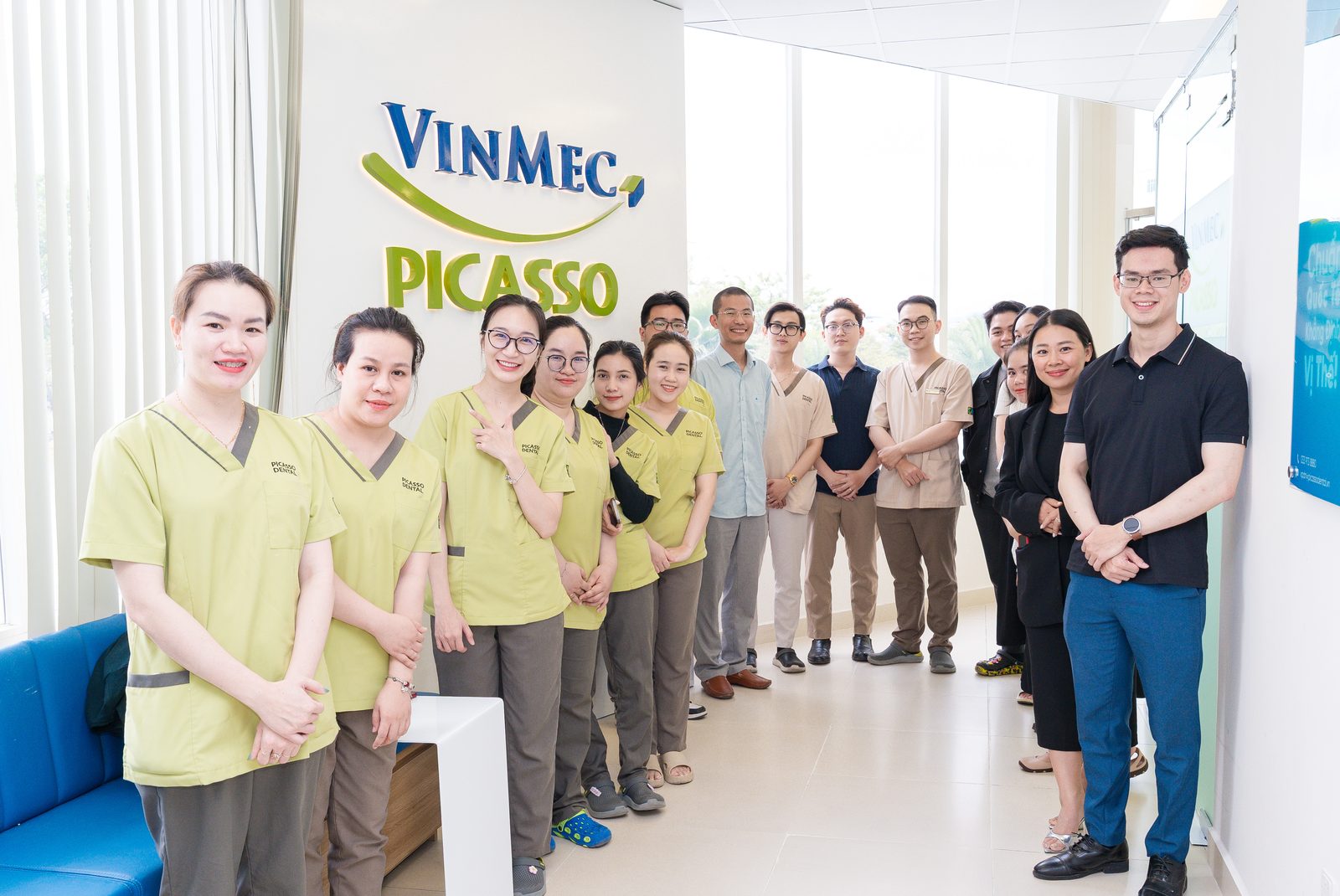
Picasso Dental Clinic - Da Nang Flagship. Overdenture surgery is typically 60 to 90 minutes per arch under local anaesthetic.
Real Case
A Real Full-Arch Implant Case.
A recent full-arch implant rehabilitation at Picasso Dental Hanoi Old Quarter, published with the patient's written consent. While this specific case combines All-on-6 with single implants, the surgical workflow, CBCT planning and brand sourcing mirror overdenture cases exactly.
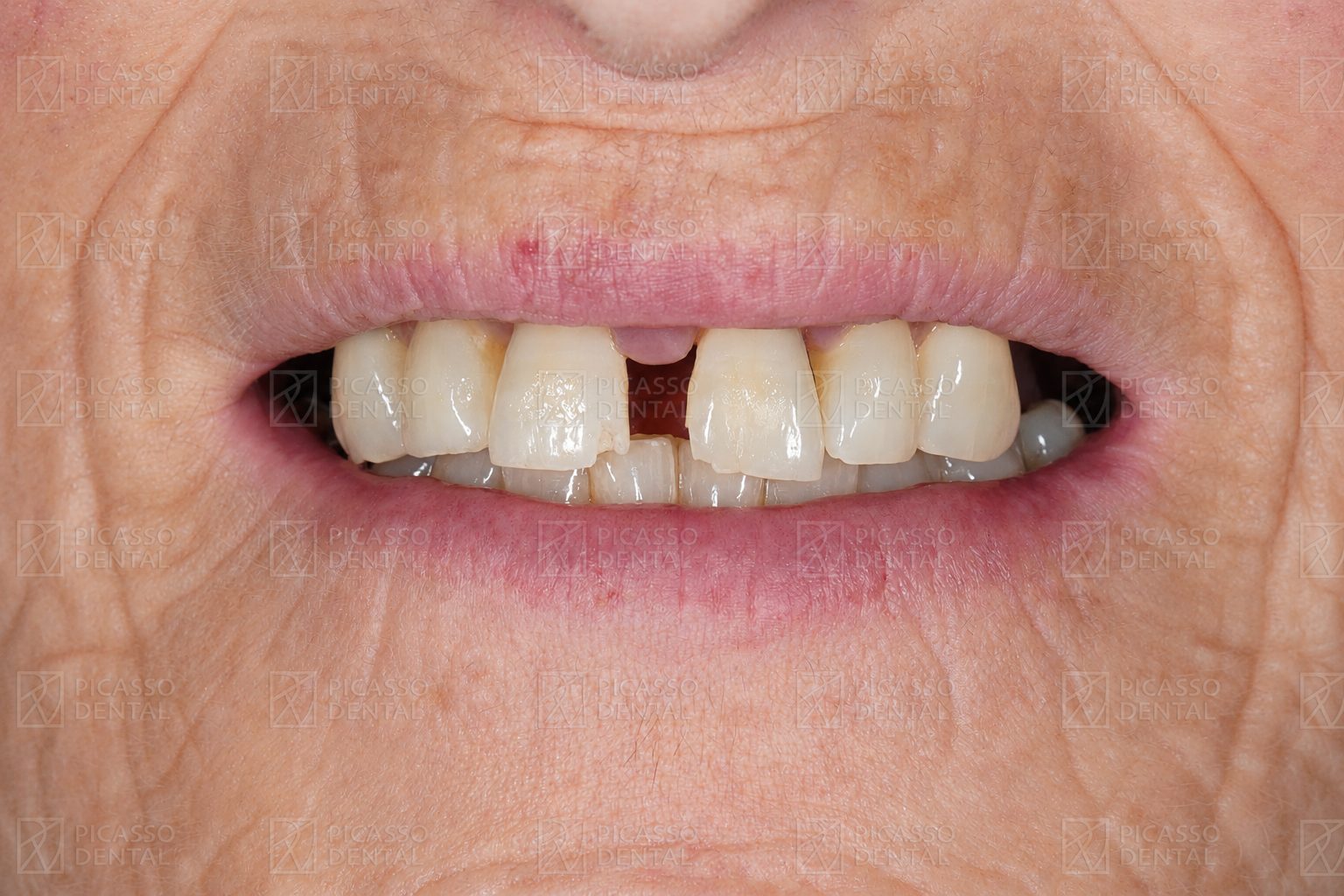
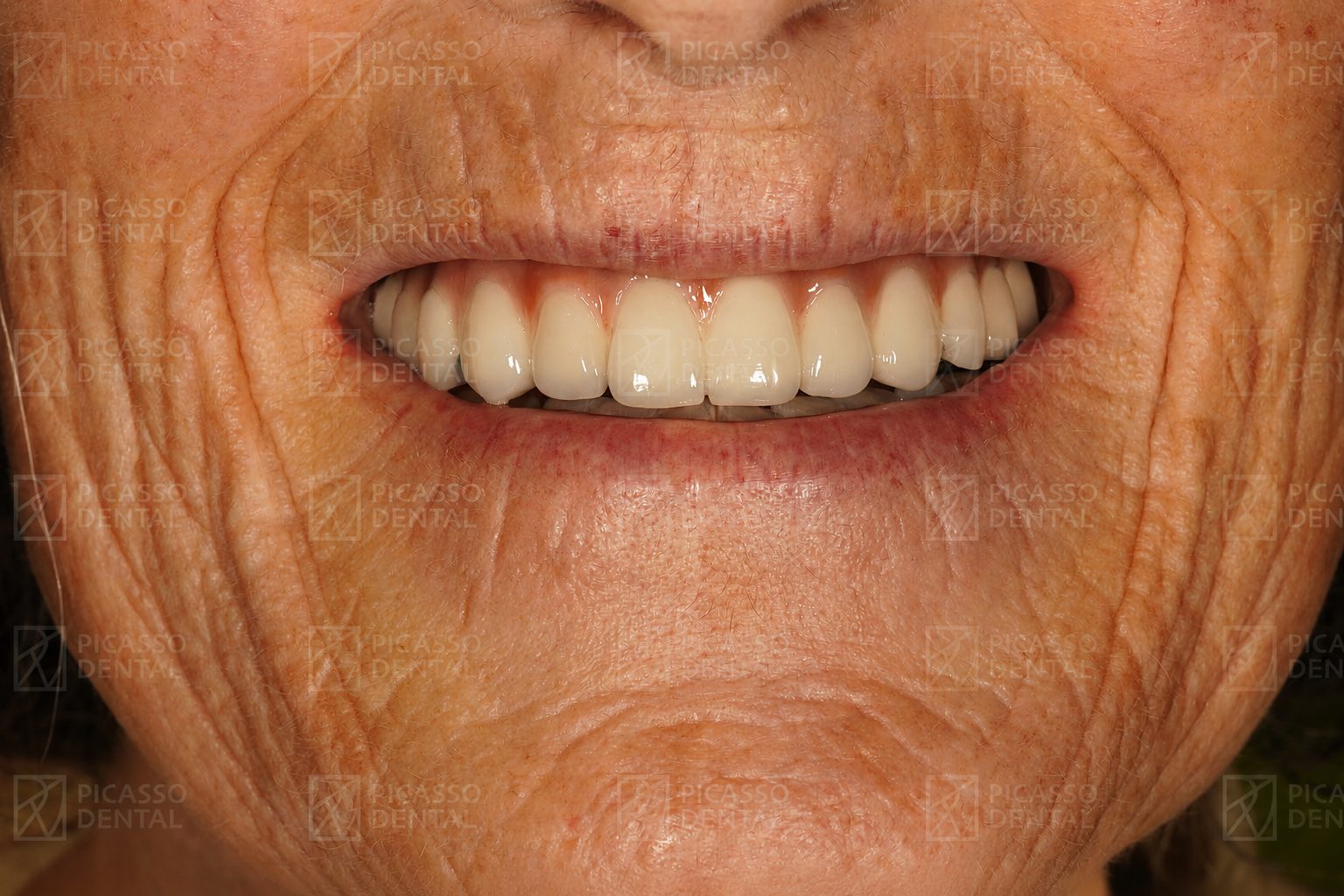
All-on-6 Upper Jaw + 3 Single Implants
- Material Osstem (Korea) implants + Zirconia crowns/bridge (Germany)
- Scope All-on-6 dental implants upper jaw + 3 single implants
- Duration 2 visits to Vietnam, 6 months apart
- Branch Hanoi Old Quarter
Brand Comparison
Overdenture vs Conventional Denture vs Fixed Bridge
Three options exist for full-arch tooth loss. The overdenture is often the rational middle ground, a substantial upgrade over conventional dentures, at meaningfully less cost than a fixed bridge.
| Criterion | Conventional Denture | Implant Overdenture | Fixed All-on-4 |
|---|---|---|---|
| Removable? | Yes | Yes (snap-on) | No (fixed in place) |
| Stability while eating | Poor (slips, needs adhesive) | Excellent (locks onto implants) | Excellent (fixed) |
| Bone preservation | No (bone shrinks over time) | Partial (at implant sites) | Yes (full) |
| Hygiene access | Easy (remove and clean) | Easy (remove and clean) | Harder (clean in mouth) |
| Feel like real teeth? | Less natural (palate covered upper) | Quite natural (palate often removed) | Most natural |
| Lifespan (prosthesis) | 5 to 7 years | 7 to 10 years | 12 to 20 years |
| Cost tier | Entry | Mid | Premium |
Many international patients mix and match: overdenture in one arch, fixed bridge in the other. See full mouth dental implants for both-arch planning.
Adjunct Procedures
When We Recommend Adjunct Procedures
Overdentures often need fewer adjunct procedures than fixed full-arch reconstructions, but some cases call for them. Decided after CBCT, never speculatively.
| Adjunct | When It's Needed | Timing |
|---|---|---|
| Bone graft | Insufficient horizontal or vertical bone at a planned implant site (less common for overdentures than fixed) | Same day as surgery or 4 to 6 months earlier |
| Atraumatic extractions | Failing teeth at any of the implant sites | Same day as implant placement |
| Periodontal treatment | Active gum disease before surgical planning | 4 to 8 weeks before any incision |
| New denture fabrication | Existing denture is worn, ill-fitting or aesthetically poor | Started in parallel with osseointegration |
| Reline | Existing denture is serviceable but loose during the 3-month healing period | Same day as surgery, repeated as gums settle |
The 2 vs 4 implant decision
Lower jaw overdentures often work beautifully with just 2 anterior implants because the dense lower bone holds the implants well and the denture itself rests stably on the gum ridge. Upper jaw overdentures typically need 4 implants because the upper bone is softer, the maxillary denture covers more area, and stability requires wider distribution.
Palate-free upper dentures
A standard upper denture covers the palate, which many wearers find uncomfortable and reports often dampen taste. A 4-implant upper overdenture commonly allows the palate to be removed from the denture design entirely. Patients report this as a major quality-of-life win independent of the stability gain.
Our Team
Who Will Place Your Overdenture Implants
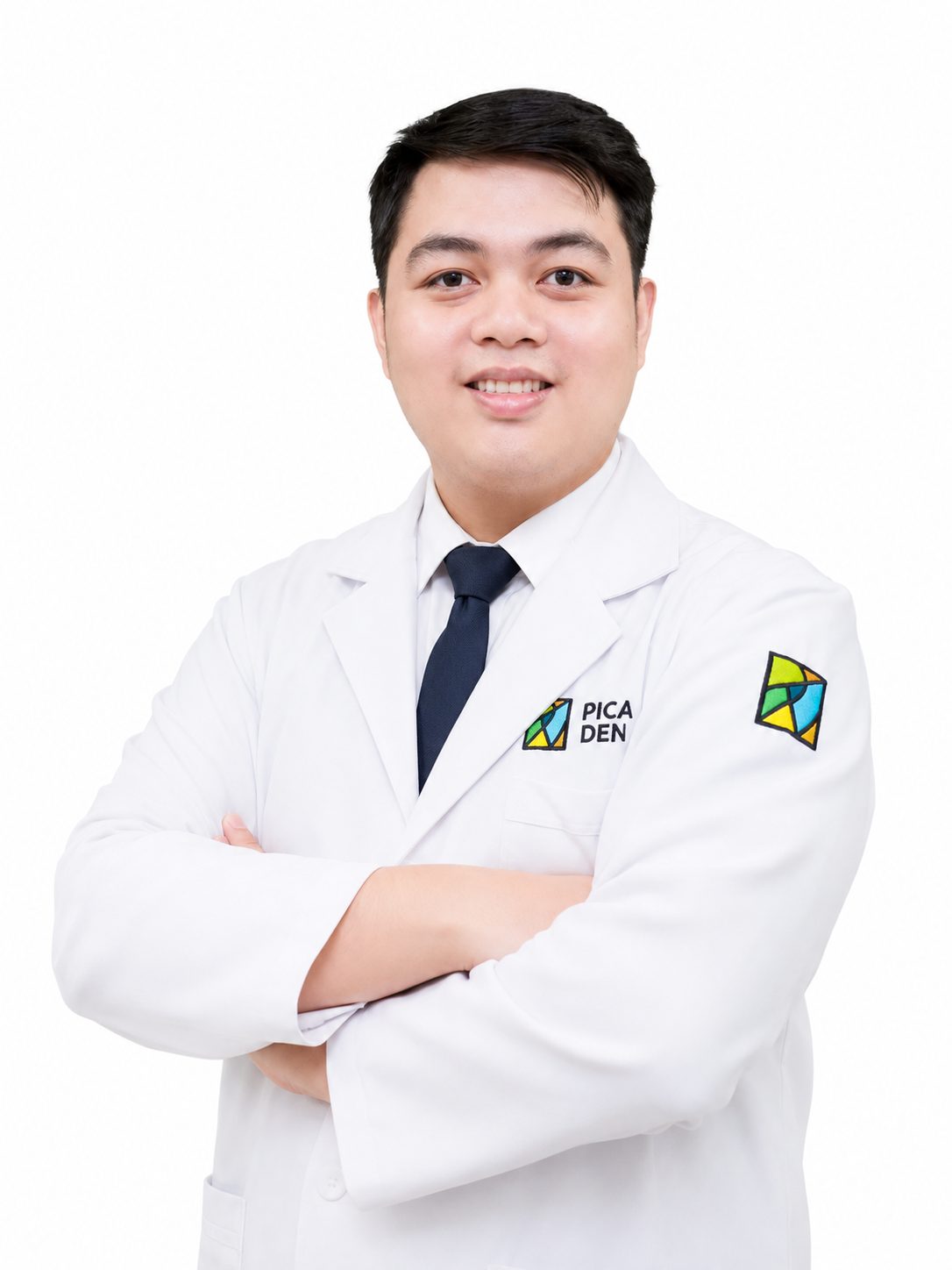
Implantology at Picasso Dental is led by Dr. Hung Le Ba Gia (Dr. Evans), our Lead Implant Specialist, with 1,000+ implants placed and hundreds of overdenture conversions on record. He performs surgical placement of overdenture implants, including day-to-day conversions. Clinical standards group-wide are set by founding director Dr. Emily Nguyen.
Lead Implant Specialist
Dr. Hung Le Ba Gia (Dr. Evans)
Picasso's lead implant specialist, with 1,000+ implants placed and hundreds of overdenture conversions on record. Overdentures are a frequent request from existing denture wearers, the surgery is straightforward and the quality-of-life impact is dramatic.

Founding Clinical Director
Dr. Emily Nguyen
Founder of the original clinic in 2013. Sets clinical standards for implant case selection, surgical protocols and prosthetic delivery group-wide. Personally reviews complex overdenture cases at the Hanoi Old Quarter flagship.
Aftercare
Caring for Your Overdenture
Daily routine differs from a fixed bridge: you remove the denture, clean it, and clean around the implants directly. The implants themselves routinely last 25 years or more. The denture is a wear item.
Morning & Night
Brush & Soak
Remove the denture, brush it with a soft denture brush and mild soap (not toothpaste). Brush the Locator caps on the implants directly with a soft toothbrush.
Most Nights
Remove Overnight
Most clinicians recommend removing the overdenture at night and storing it in a denture solution. This rests the gums and reduces fungal infection risk.
Every 6 Months · For Life
Hygiene Visit
Professional cleaning, soft-tissue check around each implant, denture inspection. Plastic Locator inserts replaced if worn. Local or with us.
Every 1 to 2 Years
Insert Replacement
Routine replacement of the plastic Locator inserts inside the denture. Quick, inexpensive, takes 5 minutes in the chair. Available from any dentist worldwide using standard Locator parts.
What to avoid
Toothpaste on the denture (abrasive, scratches the acrylic). Hot water for cleaning (warps the denture). Whitening tablets unless recommended (some damage the plastic inserts). Smoking is the single biggest threat to long-term implant success.
If you travel home after conversion
You leave with complete clinical records, your CBCT files and an implant passport listing the fixture serial numbers and attachment specifications. Your home dentist can perform 6-month hygiene visits and replace Locator inserts using standard parts available worldwide. We respond to questions over WhatsApp at any time.
Patient Stories
Implant Patients in Their Own Words
"
I flew from NZ to get my old crowns and veneers replaced (10 crowns, 6 veneers) that were cracking and falling. I knew the work would be extensive and I was nervous for the treatment, but Dr Emily and the team were supportive and professional every step of the way. From the care taken during the physical work to the regular check ins throughout my two weeks in Hanoi (and even once I had left the country) I felt supported and safe in their care. I couldn't be happier with the results of my new teeth.
Esta Fowler
"
I had 4 crowns and 4 veneers done with the wonderful Dr. Emily. I was so nervous about losing too much of my natural teeth, the horror stories of "peg teeth" terrified me, but she was so gentle and precise. I was amazed by how much of my natural teeth were preserved. Everything was explained clearly and thoroughly, and the turnaround time was fast.
Earthy Acts
"
I had 2 veneers done here in 2017 and my Canadian dentists still comment on how good they look. Thank you for the gift of a smile I feel proud of.
Josie Evans
Picasso Dental inside Vinmec International Hospital Da Nang. Hospital-based option available for overdenture patients who prefer it.
International Journey
The International Overdenture Journey
Overdentures suit international patients well: less complex than fixed bridges, easier to convert your existing denture, fewer total clinic days.
Two Trips, Healing at Home.
Surgery on Trip 1, healing at home, denture conversion on Trip 2. Two short manageable visits.
CBCT & Video Consult
Send a recent CBCT or panoramic X-ray and a few photos of your current denture. Dr. Evans reviews and replies with a recommended brand, attachment system and written quote within 24 hours.
5 to 7 days
Surgery & Reline
Consultation, CBCT, surgery (60 to 90 min per arch). Existing denture relined for healing comfort, or interim denture provided. Fly home with denture in place.
3 to 4 months
Osseointegration
Implants fuse with bone. Denture worn as soft-tissue-supported temporary. WhatsApp check-ins with our team. Local hygienist visits as normal.
5 days
Conversion & Fly Home
Locator caps or bar fitted, attachment housings cured into the denture, final adjustments. Implant passport, warranty documentation and full case file before you fly.
One Extended Trip, Healing in Vietnam.
Surgery, healing and conversion in a single 4 to 5 month stay. Continuous care under the same team.
Consultation & Surgery
Arrive, CBCT, surgery, denture relined for healing. Two weeks recovery in your accommodation of choice.
Osseointegration in Vietnam
Live in Da Nang (beach), Da Lat (mountain) or Hanoi (city) while implants integrate. Monthly clinical reviews under the same team.
Conversion & Fly Home
Locator caps or bar fitted, conversion completed in a single week at the end of the stay. Case file delivered before you fly.
Risks
Risks & Success Rates: Honestly
Overdenture surgery is among the most predictable implant procedures. Here is what the literature reports, what can go wrong, and how Picasso minimises every avoidable risk.
Documented Success Rate
Long-term clinical literature reports implant survival in the 95 to 98 percent range over 10 years. Lower-jaw 2-implant overdentures have particularly strong survival data; the McGill Consensus (2002) named the 2-implant lower overdenture as the minimum standard of care for full lower-arch tooth replacement, a position reaffirmed by the York Consensus (2009).
What Can Go Wrong
Failure to integrate at one position (rare; the remaining implants can usually still support the denture). Plastic insert wear (routine, 1 to 2 year replacement). Denture fracture (reline or replace). Peri-implantitis if hygiene is poor. Aesthetic compromise if existing denture is reused beyond its useful life.
How We Minimise Risk
CBCT 3D imaging before every implant. Autoclave sterilisation. Genuine brand fixtures with manufacturer-documented serial numbers only. Genuine Locator parts (Zest Dental, USA). Surgical planning reviewed before any incision. Patient education on daily denture hygiene at delivery.
If Something Goes Wrong
If an implant fails to integrate within 6 months, we re-place it at no additional cost. Routine attachment maintenance is covered for the first year. We retain your CBCT and clinical files indefinitely so spare parts and replacement housings can be matched precisely.
Smoking & Overdentures
Smoking roughly doubles implant failure risk. We strongly recommend stopping at least 2 weeks before surgery and remaining smoke-free for 8 weeks after. We require honest disclosure; it doesn't disqualify you, but it changes our protocol and aftercare advice.
Why 2 Implants Are Often Enough for the Lower
The lower jaw has dense cortical bone that holds implants well, and the denture itself rests stably on the gum ridge. Two anterior implants provide enough retention to stop the slipping that drives most patients to seek treatment, at the lowest cost entry point. The 4-implant lower is reserved for patients wanting maximum stability or bar-retained design.
FAQ
Frequently Asked Questions
What are implant-supported dentures?
Implant-supported dentures (also called overdentures or snap-on dentures) are removable dentures that anchor onto two to four dental implants. Unlike conventional dentures that sit on the gums and slip while eating, overdentures click firmly into place via Locator attachments or a milled bar, and can be removed for cleaning.
How much do implant-supported dentures cost in Vietnam?
Pricing depends on the implant brand (Osstem, Neodent, Nobel Biocare, Straumann), the number of implants (2 or 4 per arch), and the attachment system (Locator caps or milled bar). Per-arch pricing is published on our implant cost guide. All quotes include the implants, attachments, and denture conversion (your existing denture if suitable, or a new one).
How is an overdenture different from All-on-4?
Both can use 4 implants per arch, but the prosthesis differs. All-on-4 supports a fixed bridge that you do not remove. An overdenture is removable, you take it out for cleaning. Overdentures are typically less expensive, easier to clean, and easier to repair, but feel slightly less natural than a fixed bridge.
How many implants do I need for an overdenture?
Lower jaw overdentures often work well with just 2 implants because the dense lower bone provides good support. Upper jaw overdentures typically need 4 implants because the upper bone is softer and the denture has more area to stabilise. We recommend after CBCT review.
Will my overdenture stay in place when I eat?
Yes. Locator attachments grip the implants firmly enough that the denture does not move during normal eating, including biting into apples, sandwiches and cooked meat. Removal requires deliberate finger pressure. The slipping and dropping that conventional denture wearers experience is eliminated.
Do I take the overdenture out at night?
Most clinicians recommend yes, removing the overdenture at night allows the gums to rest and reduces the risk of fungal infection. The denture is cleaned overnight in a denture solution and replaced in the morning.
Locator attachments vs bar-retained: which is better?
Locator caps are simpler, easier to maintain, and the standard for most cases. A milled bar provides more stability and rigidity, useful for complex cases, severely resorbed ridges, or patients wanting maximum security. Bar-retained dentures cost more and require slightly more bone to fit the bar profile.
How long do the Locator caps last?
The plastic inserts inside the Locator caps wear over time and are replaced every 1 to 2 years as a routine maintenance item, this takes 5 minutes and is inexpensive. The metal Locator components on the implants themselves typically last 10+ years before consideration for replacement.
Can I have an overdenture if I currently wear conventional dentures?
Yes, this is the most common scenario. We can often modify your existing denture to fit onto the implants once they are placed (Locator housings cured into the underside), saving you from needing a brand new denture. If your existing denture is worn or poorly fitting, we make a new one as part of the treatment.
Will I need bone grafting for an overdenture?
Often less grafting is needed than for fixed full-arch reconstructions. The implant positions for overdentures are typically in the front of the jaw where bone is more reliably preserved. CBCT scanning on day one tells us definitively.
Where is implant-supported denture surgery performed?
At any of our six branches. The surgery is shorter and less complex than All-on-4 or All-on-6, typically 60 to 90 minutes per arch. Hospital-based delivery at Vinmec Da Nang and Link General Da Lat is available for patients who prefer it but is not strictly required.
How long do implant-supported dentures last?
The implants themselves routinely last 25 years or more. The denture itself is a wear item, expect 7 to 10 years before relining or replacement. The plastic Locator inserts are routine maintenance, replaced every 1 to 2 years.
Pricing
Itemised Overdenture Pricing
For published per-arch rate cards across 2-implant and 4-implant configurations on Osstem, Neodent, Nobel Biocare and Straumann, plus Locator vs bar-retained attachment options and any adjunct procedures, see the dedicated implant cost guide.
Want fixed teeth instead of removable? See All-on-4 or All-on-6. Need a conventional denture instead? See dentures comparison.
Start Here
Send Your CBCT and a Photo of Your Denture.
Get a Written Overdenture Plan in 24 Hours.
A recent CBCT or panoramic X-ray, a photo of your current denture, and a sentence about what's slipping is enough to start. Dr. Evans reviews every overdenture request personally and replies with a recommended brand, number of implants, attachment system and a written, itemised quote, at no cost and with no obligation.
No obligation · Replies from a licensed implant specialist, not a bot · Since 2013